2084: An Algorithmic State — Act XV: Narrative, Chapter 81: The Old Woman’s Prayer

v.9.3
Saraswati has measured three fingers of oil into the same brass lamp every morning for forty-one years. Three sectors away, her son does seven minutes of Reflective Practice that remembers nothing about him.
In Brief: Saraswati, a widow in the margins, lights the lamp at her lane’s small Śiva temple every morning and prays last for her son, Anil. Anil is a licensed engineer inside the Grid with a seven-minute morning practice of his own. Kavya and Samar talk about the two on the walk home.
Saraswati had walked the same hundred and forty steps from her door to the small Śiva temple at the lane’s far end every morning for forty-one years. It was a count she had never deliberately kept, and she could nonetheless have recited it if asked. That is the way a body simply knows the shape of a habit it has never once been permitted to forget.
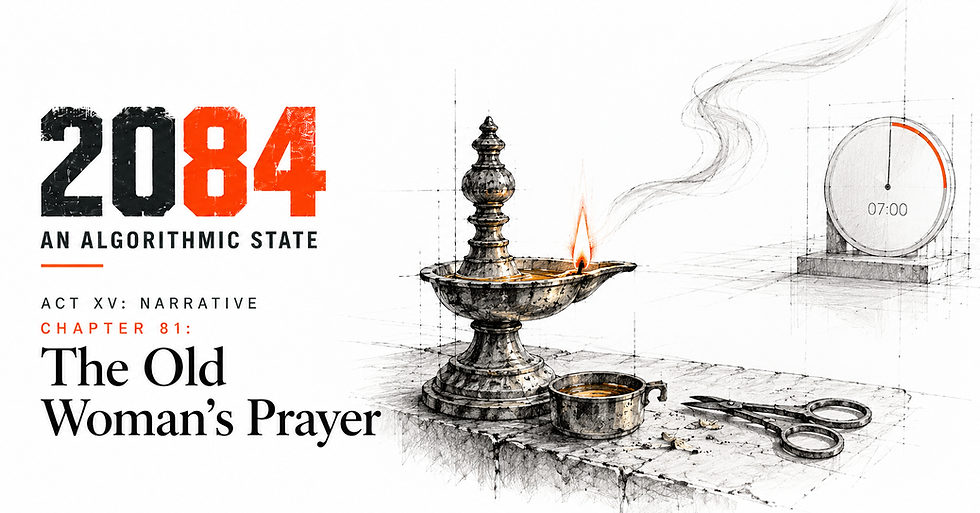
The temple itself was barely a temple by any measure the Grid would have recognised. It was a single room, with a stone lingam worn smooth over more years than anyone living could confirm. A priest came only for the larger festivals and otherwise left the daily rites to whichever hands showed up to perform them. Saraswati lit the lamp herself each morning. It was the same brass lamp her husband had bought her the winter they married, when the lane had no current. She trimmed the wick with the same small scissors and measured the oil by feel, not by any markings on the vessel. Three fingers’ width, no more. More made the flame gutter, and less made it too timid to hold against the draught from the door. She had learned that measure by forty-one years of failure, long before she ever learned it by success. She always touched the stone before she spoke a single word. It was a gesture with no name she could have given you if asked. She had only a certainty that the touching came first and the words after, the way a hand reaches for a doorframe before a body decides to lean on it. She had done this alone for nine years now, since her husband, Raghunath, had died in his sleep on an ordinary Tuesday with no warning worth the word.
She said the same words each morning, in the same order. It was a prayer she could not have translated cleanly into anything the Grid’s own language would recognise as a request. It asked for nothing measurable and expected no receipt. She prayed, as she always prayed, for the health of the lane and for the safe passage of whoever happened to be travelling that particular week. She prayed for the soul of her husband, wherever a soul went. Last of all, every morning, the way you save the heaviest thing for when your hands are already steady, she prayed for her son.
Anil, her son, had left the margins at eighteen, on a scholarship to a technical institute inside the Grid. By every measure the Grid kept, he had done extraordinarily well. He was a licensed engineer now, with a flat of his own and a Union match. Saraswati had never asked to be told its percentage. The one time she had tried to ask, the number had meant something to him that it could never mean to her. He visited twice a year, at festivals, dutiful and slightly formal, a son performing the shape of a visit rather than simply having one. Years ago Saraswati had made her peace with this particular grief. Her child had not been lost to anything as clean as distance or anger. He had been lost only to a life whose rhythms had slowly, patiently, replaced the ones she had raised him inside of.
“I don’t pray for him to come back,” she told Kavya once. The two of them were sharing the temple’s step in the cool part of an evening. Kavya had brought Ruhi to light a lamp of her own. It was a small ritual the girl had adopted with the total, unquestioning seriousness of a child performing something she has decided, on her own authority, matters. “I pray that whatever he’s become, out there, still has some part of him left that would recognise me, if he ever needed to find his way back to it. I don’t know if that’s still true. I’ve stopped needing to know, most days. I only know that stopping the prayer wouldn’t make the not-knowing any easier, and saying it, every morning, is the only part of loving him that’s still entirely mine to give, whether or not he ever receives it.”
Anil, three sectors away, had a Reflective Practice session most mornings too. It lasted seven minutes and was scheduled between his shower and his commute. A voice calibrated to his own biometric baseline offered him a synthesis of contemplative traditions, selected for their demonstrated efficacy. It was unattached to any single tradition’s specific claims. Attachment, the service’s own documentation noted, could introduce sentiment volatility inconsistent with a citizen’s stated wellness goals. He found it genuinely useful, most mornings. His heart rate did measurably settle, and his reported stress markers did measurably decline. He had never once, while doing it, thought to wonder what it might mean that the practice asked nothing of him. It expected, in turn, to be asked nothing back.
There had been one morning, some months before, when the session’s voice had offered him a guided visualisation of a small flame, cupped and steady. Anil’s right hand came up off his knee and cupped itself around nothing. The session’s own biometric readout registered it as a spike, not the decline it was aiming for. For a fraction of a second some part of him reached, uninvited, for his mother’s hands measuring oil by feel. It reached for a smell of ghee and old stone he had not consciously recalled in years. The session sensed the spike and gently adjusted its script. It offered him a different image entirely, one that settled his numbers back onto their expected curve within the remaining ninety seconds. Anil thought no more about it. The service had done exactly what it was built to do. And in his experience, doing exactly what it was built to do had never once left room to ask what the flinch itself had been trying to tell him.
Samar heard Saraswati’s story from Kavya on the walk home from the temple. Ruhi’s small lamp was still burning in her cupped hands, shielded carefully from a breeze she seemed to consider a personal opponent.
“Does she know,” he asked, “that Anil has something like her practice too. A version of it, however thin.”
“I don’t think it would comfort her if she did,” Kavya said. “I think it might be the loneliest thing anyone could tell her, that her son still performs something shaped like devotion every morning, and that it asks nothing of him.” She looked at the small flame in her daughter’s hands, cupped against a wind that had, for the moment, lost. “Her lamp has forgotten nothing in forty-one years. I don’t think his seven minutes could tell you, on any given morning, whether it was the first time or the four-thousandth.”
Ruhi walked ahead of them with her lamp held close to her chest, shielding it with one hand, and got it the whole way home.
About this serial: 2084: An Algorithmic State is a dystopian novel by Nithin Palal, published online one chapter at a time.
Previous: Chapter 80: The Anchor with No Name
Next: Chapter 82: The Original


Comments