2084: An Algorithmic State — Act XVI: Distribution, Chapter 85: The Man Who Came Looking

Ashwin Menon has spent twenty-two years standing next to documents nobody reads. In a lane he has never seen, he says one sentence to a woman at a tea stall. It contains the name of an eight-year-old girl.
In Brief: Ashwin Menon, a journalist who writes long pieces about administrative mechanisms, finds Samar’s resignation testimony in the Archive. It names Ruhi, an eight-year-old girl. He argues with himself on paper about visiting her lane, then goes looking for the Handler, and nine weeks later his piece runs.
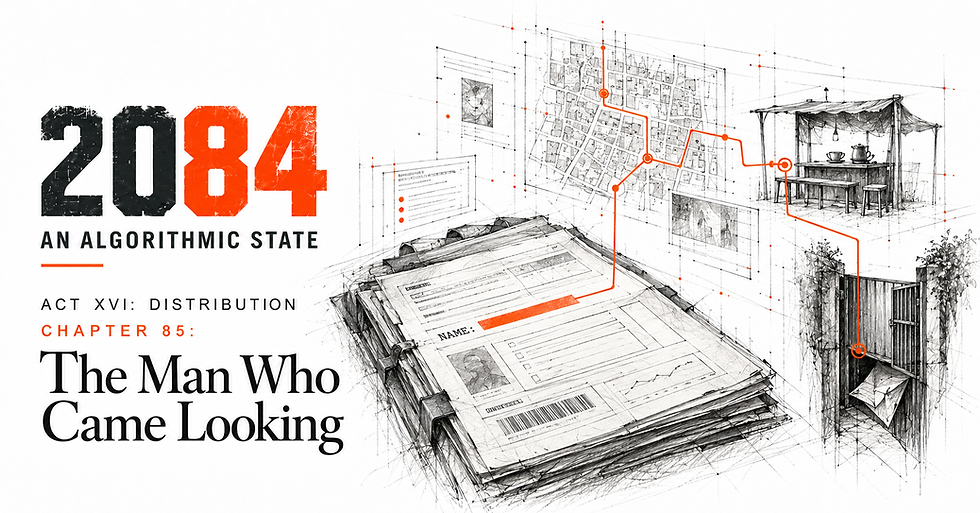
The general Archive is open to any citizen. Records retained without machine summarisation under Section 4, Subsection 20 are indexed by name, subject and referenced citizen. Indexing is a condition of retention: an unindexed record cannot be guaranteed against loss. — Archive access notice, displayed at all terminals
Ashwin Menon found the testimony on a Tuesday and thought about very little else for nine weeks.
He had gone into the Archive for something else entirely. He was doing a piece on the Continuity of Passage schedules: bereavement allocation, the eleven days, whether the number had any basis beyond convention. It was a decent piece. It would have been a decent piece. He had two interviews and a schedule table and a reasonable structure, and he abandoned all of it inside an hour of finding S. Varma.
I have learned, in the last three months, that my confirmations were executed by the model before I ever read the files they concerned.
He read it four times at the terminal and then requested a copy. The Archive gave it to him without comment, because it gave everything to anybody. That was the whole of its charter, and the reason he had built a career on it.
Ashwin was forty-four and had been doing this for twenty-two years and was, by the modest standards of the trade, good at it. He wrote long pieces about administrative mechanisms for an outlet with a readership in the low hundreds of thousands. He had a habit of taking a document nobody had read and standing next to it for twelve thousand words until people understood what it was.
He had done the Union Bureau’s variable weighting. He had done the throttle threshold, the line above which an unlicensed power draw is cut without anyone signing. Four years ago he had done a piece about the Cultural Contribution board’s variance criterion. He was reasonably certain it had resulted in two changes to the scoring rubric. The board had acknowledged neither of them, and both had happened.
The six-second gap was the largest thing he had ever had in his hands.
He did the work properly.
He read the amendment. He read the ratified text and the four-minute session record and the Secretariat commentary. He requested an interview with a Directorate spokesperson and was granted one, and the spokesperson was courteous and told him nothing. He tried the Personnel Integrity Division and got the standard line and expected to.
He found R. Sen’s name nowhere, the Handler whose disclosure had started the amendment. This surprised him at the time, and he understood it later. Someone had taken care over that, and had taken it thoroughly, and he never did learn who.
He found S. Varma everywhere, because S. Varma had put himself everywhere on purpose, in a document he had written knowing exactly what indexing meant.
And in the middle of it, in the third paragraph, indexed as a referenced citizen because the Archive indexed every name in a retained record without exception:
Her name is Ruhi. She is eight years old.
He thought about it. He would say so, if a record existed that took it.
He thought about it for a fortnight before he went. He wrote out the argument on both sides, on paper, which was his practice, and the argument came out like this:
Against. She is eight. Her mother did not choose this. The name is in the record because a man decided it should be, and the mother was not consulted, which is itself part of the story and possibly the best part of it. For. The name is already public. Permanently, unexpiring, indexed, on a terminal any citizen can walk up to. I did not put it there. If I write this piece without ever having stood in that lane it will be a piece about a document, and a piece about a document changes nothing, and I have watched pieces about documents change nothing for twenty-two years. The variance criterion changed because I found the two people it had happened to.
He decided he would go. He would ask nobody anything about the child, and would ask only for the Handler.
He is aware, now, of how that decision looks written down.
He went on a Thursday and it took twenty minutes.
He asked three people. The first was a woman selling fruit from a cart, who looked at him and tilted her head at nothing in particular and went back to her weighing. The second was a boy carrying bread who did not stop. The third was a woman at a tea stall on a corner. She was polite, and she let him finish, and then said she did not know anybody of that name.
Then he said it. Here is the thing, here is the sentence, and he has taken it out and looked at it since. He said, “It might be easier if I say the child. Ruhi. I’m looking for the Handler who resigned over a girl called Ruhi.”
The woman’s face did not change at all. That was what he noticed at the time. Nothing changed. She said she was sorry, she didn’t know, and would he like tea, and he said no thank you, and she said it was no trouble, and he said honestly no, thank you, and left.
He walked back to the checkpoint feeling that the afternoon had been a failure and that he would have to write the piece from the documents after all.
Behind him, in a lane he had left, Fatima stood at her tea stall for about a minute doing nothing at all. Then she closed her stall in the middle of a working day, and went to find Zainab.
He does not know this.
He does not know that a mother four hundred metres away spent four hours that afternoon turning over a fact she could not put down. The lane told him nothing, and that was the lane protecting itself, and the price of it was that he went home believing the afternoon had been uneventful.
The piece ran nine weeks later at fourteen thousand words.
It was good. It was, in the honest assessment of a man who does not have many of these, the best thing he has written. It laid out the six-second gap from the architecture down. It printed the audit-log timestamps and quoted the testimony at length. And it made an argument about Amendment 4.9, the disclosure rule the committee had ratified that year, that a number of people found persuasive. A disclosure requirement bolted onto an unchanged architecture, it said, is not a reform but a receipt.
Three things followed from it, and Ashwin knows about two.
He knows that the Directorate issued a clarification, and that the clarification was worse than saying nothing and was widely observed to be worse. He knows that five months later a Grade III Handler in Sector 6 wrote him a long letter about what she had started doing at her desk. He wrote back, and they have corresponded since.
The third is a woman named Kavya Nair, who has never heard his name and never will. For some years now she has made a specific calculation before she allows anything about her work to be written down anywhere. She does it quickly, almost without noticing, the way a person checks a door.
He has been back to the sector twice, for other pieces. He does not know it is the same sector.
He is a man who did twenty-two years of careful work on one principle. The erasure happens in the summary, and the fix is to put the original where it can be found. He has never once had to sit in the room on the other side of a found original.
He is working now on something about the Cultural Contribution board, a follow-up to the variance piece. It is going slowly, because he can no longer get artists in the unmapped subsectors to talk to him, and he cannot work out why.
About this serial: 2084: An Algorithmic State is a dystopian novel by Nithin Palal, published online one chapter at a time.
Previous: Chapter 84: The Polite Man


Comments