No Problem — Act I: Hartal, Chapter 1: God’s Own Country
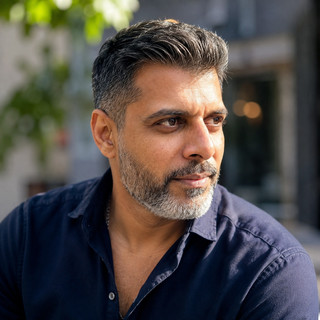
A British passport, a Savile Row suit and one week in Palakkad. Pavan Nair has come to his father’s town to kill a man. On his first morning the whole town shuts, and the man with the gun says tomorrow, no problem.
In Brief: Cochin, 10 March. Pavan Nair lands from London in a wool suit and a fedora, with a British passport and a job to finish in one week. A driver called Shibu takes him to Palakkad, his father’s hometown, where he checks in under his real name and waits for a weapon.
The jet bridge ended, and India began.
It began with the air. The humidity entered the bridge like an invasion force. It was warm, wet and thick with jasmine and aviation fuel and something sweet that might have been jackfruit or might have been a city waking. The air had weight. It had texture. It had, Pavan felt, opinions.
His suit was charcoal grey worsted wool, single-breasted, two buttons, made by a small firm on Savile Row that had been dressing gentlemen since 1894. It had survived nine hours of economy class in a state of wilted dignity, the shoulders soft, the collar damp.
His tie was burgundy silk, knotted in a half-Windsor, never a full Windsor, which he considered the knot of men who confused effort with elegance. His black Oxfords were polished to a finish that could, in theory, have been used for surveillance. On his head sat a charcoal felt fedora.
The man inside these clothes was five foot five, weighed fifty-eight kilograms, and had the physical presence of a pencil. He had narrow shoulders, narrow wrists and a chest the Savile Row firm had tactfully described as “compact.” His face was angular and fine-boned, Nair cheekbones, his mother’s complexion. It wore an expression of such careful neutrality that it could have been mistaken for mild indigestion. He was the last person in any room a witness would describe afterwards, and over ten years and four continents this had been his most valuable professional asset. Nobody looked at Pavan and thought danger. They thought “visiting nephew” or “junior accountant” or “that poor man, he must be lost.”
Immigration was a queue. A long queue. A family of eleven occupied a space designed for two and was conducting a small parliamentary session about passports.
An immigration officer, a woman in her fifties with spectacles and a bindi, looked at his passport, then at him. The passport said British national. The face said Indian. The contradiction had served him well in other countries. Here it felt less like camouflage than a prelude to questions.
“Purpose of visit?”
“Personal.”
“Duration?”
“One week.”
She stamped. He moved on.
A car had been booked to take him to Palakkad.
The driver was a man named Shibu, approximately forty, approximately five foot six, and approximately the happiest human being Pavan had ever encountered.
He reached for the holdall. Pavan did not release it. Shibu’s hand remained on the handle. Pavan’s hand remained on the handle. They stood like this for three seconds, two men and one bag in a car park in Cochin at five in the morning. Then Shibu released the handle and opened the rear door instead.
“Welcome, welcome, sir. Palakkad, no? Four hours, sir. Maybe three. Depending.”
“Depending on what?”
Shibu’s smile widened. “Depending, sir.”
The car was a white Maruti Dzire. A small Ganesha sat on the dashboard. A jasmine garland hung from the rearview mirror and competed with a pine air freshener.
Shibu drove in a state of continuous, low-level warfare with every other vehicle on the road. He honked at buses, at trucks, at motorcycles carrying families of four: father driving, mother holding a baby, toddler gripping the mirror, all of them helmetless, all of them serene. At one junction near Chalakudy, he honked at nothing at all. A pre-emptive honk.
“Sir is from London?” Shibu asked, making eye contact in the rearview mirror while the car drifted across two lanes at seventy.
“Yes.”
“London. Very good, sir. My cousin’s brother-in-law is in Croydon. Tesco. You know Croydon, sir?”
“I am familiar with it.”
“My nephew also. Bahrain. Good salary. Dinars. Everybody is going, sir. London, Dubai, Bahrain, Australia. Even Canada now. My neighbour’s son, MBA, then PR, then citizenship. That is the plan. Everybody has a plan.”
“Does the plan work?”
Shibu considered this. “Plan is there, sir. Working is different.” He overtook a lorry whose rear was painted with the words BLOWING HORN PLEASE. “But...”
He stopped. The smile did not leave his face.
“Children are going, sir. That is the modern way. We are staying. That is also a plan.” He adjusted the rearview mirror. “Keralam is like that, sir. Everybody going, everybody staying, everybody having an opinion about both.”
A cow. Shibu honked. The cow did not move. The whole highway, buses, trucks and cars, bent around it with the ease of long habit.
“Cow is there, sir,” Shibu said, which was both an observation and a complete explanation.
“I can see that.”
“We go around. Cow is not moving. Cow has decided. We are respecting the decision.”
Shibu swerved, and the cow remained where it was.
Pavan sat in the back seat and watched the way he always watched unfamiliar ground: exits, choke points, who stood still, who moved with purpose, what could become a delay.
Kerala was green. An aggressive green covered the hills, the roadsides and the gaps between buildings, where creepers had taken over the walls. On compound walls, political slogans had been painted in red and white, some fresh, some fading into the plaster. And along every village road, three-storey houses with Italian marble and German fittings stood shuttered and empty.
“Gulf houses, sir,” Shibu said, noticing where he was looking. “Owner is in Dubai. Or Bahrain. Or Qatar. Sending money, building house, not living in house. Very common. My road also, seven houses, three are empty. Beautiful houses. Nobody home.”
His parents had been part of this machine. He had spent most of his life not coming.
“Who maintains them?”
“Nobody, sir. That is also very common.”
Churches, mosques and temples passed the window as often as petrol stations, sometimes side by side.
They reached Thrissur at 8:15 a.m., which was when the elephants appeared.
Elephants. On a national highway. On a Tuesday. They walked in single file down the centre of the road, in gold-fringed caparisons, their foreheads painted. Men with palm-leaf umbrellas walked beside them, and men beating drums.
Traffic stopped.
A bus driver turned off his engine.
“Pooram rehearsal, sir,” Shibu said. “Thrissur Pooram. Biggest festival in Kerala. They are practising.”
“Practising.”
“Yes, sir. The elephants must practise. Otherwise, how will they know what to do?”
Pavan considered this. In his experience, rehearsals were for orchestras, military operations and assassinations.
Shibu explained for the next twenty-two minutes of standing still. Two temples, thirty elephants, half a million people, and fireworks the town argued about for the rest of the year.
“You should see, sir. Very beautiful. Elephants standing, thirty of them, gold, drums, the kudamattam, that is the parasol exchange, sir, very exciting. And fireworks. The best in the world.”
“When is it?”
“April, sir. You will be here?”
“That depends on how quickly my work is concluded.”
“Everything is depending, sir. Even elephants.”
Pavan watched thirteen elephants cross a national highway to rehearse for a competitive parasol display.
Palakkad announced itself not with a sign but with a gap. The hills pulled apart. The sky widened. Rice paddies stretched to the horizon, flat and bright. Through the Palakkad Gap came a wind hotter and drier than anything since landing. It blew from Tamil Nadu, the other state just over the hills. Palakkad was Kerala’s borderland. People here spoke Malayalam with a Tamil sound in it, and the rest of Kerala said they were not quite Keralite.
At 10:23 a.m. they entered the town. Shibu announced the time with the pride of a man who had broken a land speed record. The elephants were now “small delay only, sir.”
Shops were raising their shutters. Women in cotton saris walked to the temple with brass vessels. Party flags hung from electric poles in alternating colours, as though the town’s wiring had developed political opinions. Men in white mundus sat at tea stalls reading newspapers with grave concentration.
Hotel Nirmala Residency had last been improved in the 1990s.
Shibu stopped the Dzire at the entrance and turned off the engine. He took a business card from the sun visor and handed it through the window.
“My number, sir. Anytime you need, you call. Palakkad I know. Every road, every shortcut, every...” He paused, searching for a bigger word. “Everything, sir.”
“Thank you.”
Shibu smiled the smile. “Palakkad is good, sir. You will see.”
He drove away. At the corner the horn sounded once, not at anything, just a farewell. Then the street absorbed it.
The lobby was a desk, two plastic chairs, a calendar showing Guruvayur temple and the month of January, and a man watching cricket on a phone propped against a ledger. It was March. The receptionist looked up with the slow reluctance of someone asked to choose between cricket and employment.
“Good morning,” Pavan said. “I have a reservation. Pavan Nair.”
The receptionist turned the ledger toward himself and ran his finger down the page. The finger stopped. Started again. Stopped. “Nair,” he said. “Pavan Krishnan Nair?”
“Yes.”
Pavan placed his British passport on the desk. He had made this calculation in London. In a city, a fake name was operational hygiene, because nobody checked. But Keralam had thirty-five million people with an opinion about everything, and its society ran on knowing who was whose cousin. Here a fake name was a ticking bomb. Someone would ask Nair? Which Nair? If the answer did not lead back to a real family, a real pharmacy and a real father who had left in 1979, the cover was finished. So he came as himself, with his real name, his real passport and his real story, an NRI visiting his father’s hometown for the first time. In London, names could be arranged. Here, they arrived carrying lineage.
The receptionist’s pen did not work. He produced a second, and it did not work. A boy ran in from a back room with a third. The passport number was completed. The boy did not come back for the pen. The pen had been a gift to the process, not a loan.
“How long you are staying, sir?”
“One week.”
The receptionist looked at him. “One week only?”
“That is the plan.”
The receptionist gave him a key on a wooden block large enough to double as a weapon. “Room 207, sir. Second floor. Lift is not working.”
“When will the lift be repaired?”
“Someone will come, sir.” He called out. “Jishnu.”
A thin boy with an aspiring moustache appeared. He had no uniform and no cart, and he did not offer to carry the holdall.
“207. This way, sir.”
Jishnu led him up two flights of stairs that smelled of phenyl and old stone. He walked ahead and gave a running commentary on the hotel’s amenities.
“Hot water is there, sir. Morning six to eight. Sometimes nine. Depending on the boiler.”
“Is the boiler reliable?”
“Boiler is old, sir. But it is working. Mostly it is working.”
“Mostly.”
“Mostly, sir.”
He opened the door to 207 and stepped aside. “AC remote is on the bed. If it is not working, press harder. Checkout is twelve noon. Breakfast is seven to nine. I will be there also.”
“You are also the waiter?”
“I am everything, sir,” Jishnu said.
Room 207 qualified as a room, though only just. A bed with a mattress stuffed with springs. A wooden almirah whose door did not fully close. Curtains that had once been green and were now a colour nature had not named. In the bathroom, a shower head, a toilet and a bucket shared a space designed for two of them, and the bucket had won.
The AC unit bore a brand name Pavan did not recognise. When switched on, it passed through several stages of respiratory complaint and settled into the drone of a small aircraft preparing for a take-off it would never make. It produced cool air now and then.
Pavan set his holdall on the bed. He checked the window: second floor, a drop to a concrete ledge, then a six-foot fall to the service lane. Viable. He tested the door lock: a single deadbolt, no chain. Four paces from the bed to the door. Eleven from the door to the stairwell. He hung his jacket in the almirah. He unknotted his tie.
The shower switched between scalding and glacial with no pattern he could find. The cold hit his shoulders, and for a moment he was in the stairwell in Zurich. The stairwell had been colder than this. He turned the tap and the water went scalding again. The towel was the size of a large handkerchief.
He laid out the kurta and pyjama, the Moleskine, the Pelikan pen and the Graham Greene paperback. His one iPhone held two SIMs. The British SIM carried the London life: Kristy’s WhatsApp updates on the cat, the banking app, the encrypted app. The Indian SIM, bought at Cochin airport, was for local use.
The almirah’s latch was decorative. From a leather roll of lock picks, torch and nylon cord he took a small padlock and hasp, and fitted them with a screwdriver. Now the almirah locked. The holdall went under the bed, zip facing the door, handle within reach from the floor.
He stood at the window. Palakkad looked back at him.
At 11:00 a.m., a message. Pavan did not make calls on operational matters. Calls produced voice prints.
He typed: Arrived. Ready for collection. Advise location and time.
The contact was a man whose name he did not know and did not wish to know. This man could supply a weapon, and the protocol was a dead drop: a location, an item, separation in time. No meeting. No voice. No face. The intermediary in London had arranged everything.
The reply came in four minutes.
Today difficult sir. Hartal. UDF called. Whole Palakkad closed. Tomorrow no problem.
Pavan stood at the window and watched Palakkad prove the man right.
It took fifteen minutes. The street had been busy with autorickshaws, motorcycles and a man pushing a cart of coconuts. Now it drained away. Shutters came down with a metallic finality, like a sentence being completed. Autorickshaws disappeared into side lanes. Even the tea stalls pulled their shutters halfway, which in Kerala meant: we are closed, but come to the side door and we will give you a glass.
In twenty minutes, MG Road was empty. Not quiet. The crows, the temple loudspeakers and the mosque’s azaan all continued on schedule, because God did not observe hartals. The people had simply gone.
Across the road, a chayakkada uncle stood with his hand on the shutter, half-down. He looked up the road. He looked down the road. He adjusted the shutter’s angle, not closing it fully, leaving the gap that meant what it had always meant. Then he went inside.
His phone buzzed. An unasked-for text from Shibu: Hartal sir. All closed. If you need anything call me sir. I am at home only. No problem.
At noon, hunger and restlessness drove him downstairs. The hotel’s restaurant had six tables, fluorescent lights and a television showing Asianet News, and it was open. A hartal closed shops and transport. It did not close kitchens. There were principles, and there was rice.
Jishnu appeared.
“Meals, sir?”
“What would you recommend?”
Jishnu’s expression did not change. “Meals, sir,” he said.
“Very well. Meals.”
What arrived was a banana leaf. On it lay a mound of red rice, sambar, rasam, two vegetable dishes he could not identify, a pickle, a papadam, a banana and a small steel cup of payasam.
Everyone else was eating with their hands, so Pavan ate with his hands. On the third attempt, the rice ball fell apart. A grain of red rice sat on his left cuff for four seconds before he noticed it and removed it with the focus of a man disarming an explosive.
He persisted.
The steam rose from the rice and sambar together: coconut oil, curry leaves and something underneath that he could not name. For a second it seemed almost nameable. Kitchen heat, steel tumblers, his mother turning from a stove. Then it was gone.
The pickle went off like ordnance, and he drank three glasses of water.
Jishnu returned with a fourth glass of water, unasked, and set it down.
“OK, sir?” Jishnu asked, from a safe distance.
“Perfectly fine,” Pavan said, in a voice altered beyond dignity.
“Buttermilk, sir? For the...” Jishnu gestured at his own mouth.
“That will not be necessary.”
Jishnu nodded. He did not argue. Forty seconds later he came back with a glass of buttermilk and placed it beside the water. When Pavan looked at him, he was already walking away.
Pavan paid in cash, three hundred-rupee notes. The notes felt less foreign than they should have. That irritated him.
He climbed back to his room.
Palakkad lay still under the afternoon sun, empty and shimmering. A single dog trotted down MG Road as if the afternoon had promoted it. In one of the closed houses, a pressure cooker whistled.
At four o’clock, the town came back to life. A shutter went up. An autorickshaw appeared at the junction, idling, as though back from somewhere else. Within thirty minutes, MG Road was humming again, at half volume.
Pavan went downstairs at six. Two of the six tables were now occupied, and the television had moved from news to a cricket match. Jishnu was behind the counter, pouring tea from one vessel to another from a great height, with a deep indifference to scalding.
“Tea, sir?”
“Yes. Black, no sugar.”
Jishnu looked at him. The look lasted one second longer than a look should last when a man has ordered tea.
“Black tea, sir?”
“Yes.”
“No milk?”
“No milk.”
“No sugar?”
“No sugar.”
Jishnu poured the tea. It arrived in a small steel tumbler, black, as requested. Beside it, unrequested, placed with the casual skill of a chess player advancing a pawn, was a small steel jug of milk and sugar.
Pavan looked at the milk. Jishnu was already at the other end of the counter, wiping something that did not need wiping.
He drank the tea black. The milk and the sugar remained.
Outside, MG Road was busy again. The tea stall’s shutter was fully raised, the gap no longer needed.
From the direction of the mosque, the azaan sounded for Maghrib, the dusk prayer. Across MG Road, lights came on in houses where families had waited all day for this signal. Ramadan. The smell of something fried drifted across the road from a house with open windows.
By eight, the night had assembled its sounds: dogs, the bass note of a KSRTC bus and, under everything, the crickets.
Through the wall to his left, someone was watching a serial. The volume suggested they were hard of hearing or wished to share the plot with the whole second floor. Through the wall to his right, silence. The silence had the quality of an occupied room gone still. It gave him a small, unreasonable feeling he had known before certain doors: that he was not the only one measuring the space.
Alarm set for six. Kurta and pyjama, because a man had standards, even in a hotel room that had none. The desk. The Moleskine, leather-bound, squared pages. The Pelikan pen, loaded with blue-black ink.
He wrote:
10 March. Day 1. Arrival Cochin 0447. Transit to Palakkad, 0500 to 1023. Driver: local, named Shibu. Reliable, talkative. Hotel Nirmala Residency, Room 207. Real name, British passport. Small town, fake identity unsustainable. NRI cover sufficient. Weapon acquisition delayed by hartal. Contact confirms tomorrow. Target location: Palakkad, address per dossier. Reconnaissance postponed. Operational assessment: environment unpredictable. Adjust.
About this serial: No Problem is a comic novel by Nithin Palal, published online one chapter at a time.
Next: Chapter 2: The Weapon
Comments